Pendrell (OTC:PCOA)

Ticker: OTCPK:PCOA Price: $640 Shares outstanding: 256.8k Market capitalisation: $164m Net cash: $185m Enterprise value: ($21m)
Opportunity
On the 16th December 2017, Pendrell Corporation de-listed its stock from the NASDAQ and became an over-the-counter (OTC) traded security. This created a forced selling event that caused investors unable to hold OTC traded stocks to push the stock price to a level below the net cash per share. The stock fell from ~$700/share before de-listing to a low of ~$550 despite holding net cash per share of ~$720.
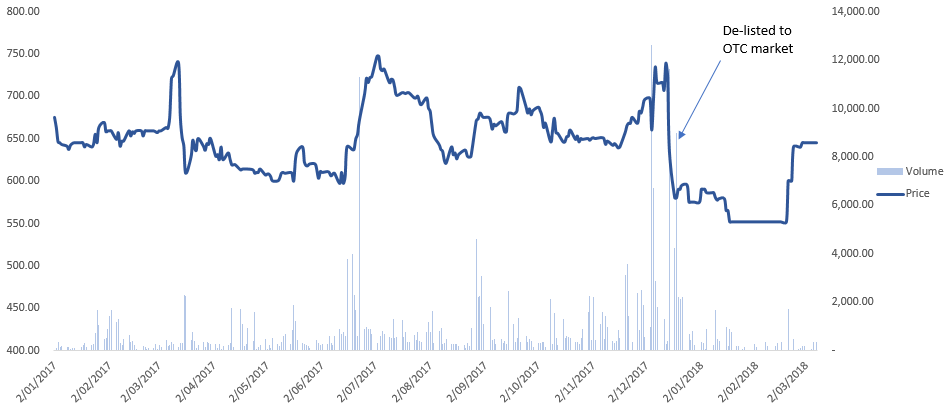
Although the share price has recovered somewhat from these lows, in no small part due to the company re-purchasing stock, I believe at current levels PCOA offers an attractive, asymmetric setup for nimble, unconstrained investors to take advantage of.
History
The original company was formed in 2000, with the intention to develop and operate a global satellite communications system. The business never reached a point of viability and in 2011 it began selling assets before being transitioned to a “Liquidating Trust” in 2012. This process led to the creation of ~$2.4bn in Net Operating Losses (NOL’s) which should provide a tax shield for 20 years post their creation (i.e. valid until 2032).
For the next few years, Pendrell acquired and monetized intellectual property (IP) rights. Essentially, they acquired companies that possessed technology that could be licensed to third parties. This next endeavour was not overly successful, but has generated free cash flow in the last few years.
In 2014, the company hired Lee Mikles who has focussed on divesting the IP portfolio, reducing overhead costs and looking to acquire an operating company that can “generate solid, stable income streams.” Mikles has a solid history as a shrewd capital allocator and despite being offered numerous deals over the past few years he has not pulled the trigger due to “high valuations that we attribute to inexpensive and widely available capital.”
In 2017, the company decided to de-list the stock from the NASDAQ to save ~$1m in listing costs p.a. Due to the severe dislocation between price and value that this process caused, the company opportunistically repurchased shares and “intends to repurchase additional shares in 2018 if those repurchases are accretive to our remaining shareholders.”
The people involved
Craig McCaw
Founder of McCaw Cellular, which was sold to AT&T in 1994 for $11.5bn
Took control of Nextel in 1995 for ~$1bn, which was sold to Sprint in 2006 for $6.5bn
Owns ~24% of the shares outstanding in Pendrell and ~67% of the votes through the super voting rights
Bill Gates
No background required
Owns 1% of the company through Mente LLC, but 13% of the votes
Lee Mikles
Co-founded a SPAC which went on to acquire FutureFuel in 2008 – took share price from ~$5 to over $12 at time of departure (in 2015) while paying out nearly $2 in dividends
Estimated net worth in excess of $30m
Owns ~2% of the company but has numerous option packages
Took a base salary of $6,000 (that’s not a typo) in 2016
So, what’s the bet?
Essentially, that a group of highly successful and incentivised business people, can make an attractive acquisition. Given the market is currently offering us a chance to buy the company for negative $21m, I estimate we have at least 3 years before our capital would begin to be impaired.
Currently, the business is profitable, however, if we assume the revenues cease, I estimate there are ~$6.5m in annual operating costs (FY17 G&A less the estimated $1m in annual savings from NASDAQ de-listing that management states)
Therefore, if we purchase the company for negative $21m and the annual cash burn is ~$6.5m, it would be three years before the net cash balance would equal our purchase price: Current cash balance: $185m Annual cash burn: $6.5m Implied cumulative burn over three years: $19.5m Year 3 net cash: $185 – 19.5 $165.5m Current market cap: $164m
Therefore, in three years’ time, even if they burn $6.5m in cash per annum, the net cash on the balance sheet will be equal to our purchase price, and all we will have lost is our cost of capital.
Risks
Time
Poor acquisition
What’s the upside?
In short, no idea. It really depends on the acquisition they make and then how much value they can create through operations or financial engineering.
In the short run, it could trade back to the cash backing ($720 or 12.5%) and the $2.4bn in NOL’s have some value (what that is, I don’t know). Therefore, downside is limited, and upside is unknown. I believe this offers an attractive place to park cash given the low cost of capital currently (i.e. interest rates <3% on cash at present)
Source
https://www.sec.gov/Archives/edgar/data/1359555/000156459018002331/pco-10k_20171231.htm